

Choosing the right needle makes cross stitch easier and helps protect both your fabric and your thread. For beginners, the goal is simple: a needle that’s easy to thread and slides smoothly through the fabric.
Embroidery Needles vs Cross Stitch Needles
Cross stitch is a type of embroidery, but it doesn’t use the same needles as most other embroidery techniques.
Many embroidery projects use tightly woven fabrics where the needle needs to pierce the fabric threads. Those projects often use sharp embroidery needles, called sharps, crewel or embroidery needles.
Why Tapestry Needles Are Best for Cross Stitch
Cross stitch is different. It’s worked on fabric with clearly spaced holes, like Aida or other evenweave fabrics. Because the holes already exist, you don’t want a sharp point.
You want a needle that slides easily through the holes in the fabric and has a large eye that is easy to thread because you’re often using multiple strands of floss. A tapestry needle has a rounded point and a large eye. It slides into the holes without splitting the fabric threads.
For cross stitch, tapestry needles are the better choice.

Sharp pointed needles could slide through the threads of the Aida fabric instead of the holes, which will make your crosses wonky and make your floss fray faster as you sew.
You’ll find tapestry needles in the sewing needles section of most craft stores.
Common Beginner Needle Mistakes
A few small needle-related mistakes can make cross stitch feel more difficult than it needs to be.
- Using a sharp needle instead of a tapestry needle
This can split the fabric threads and lead to uneven stitches. - Using a needle that’s too small for the fabric
If the needle struggles to pass through the holes, it’s probably too fine for your fabric count. - Using a needle that’s too large
An oversized needle can stretch the holes and distort the fabric over time. - Assuming “any embroidery needle will do”
Cross stitch is specific. Matching the needle to the fabric makes a noticeable difference to how smoothly you stitch.
Getting the needle right early on removes a lot of unnecessary frustration.
Buy an Assorted Pack First
If you’re just starting out, skip the single needles and buy an assorted pack of tapestry needles. Most packs cover a spread of sizes, usually somewhere between 22 and 26, which is exactly the range beginner fabrics call for.
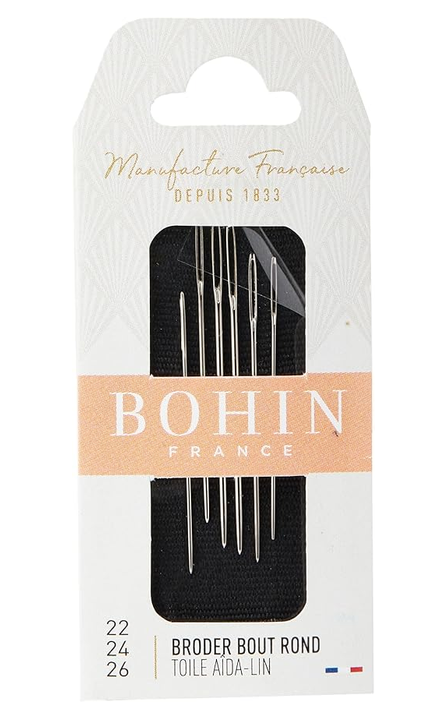
Then stitch with each of them. A size chart can tell you which needle fits through the holes in your fabric, but it can’t tell you which one feels right in your hand. Some stitchers like a longer, slightly heavier needle they can really grip.
Others (me) want the finest thing that will still take the floss. You only find that out by stitching, and an assorted pack lets you try without buying five separate packets.
Does the Needle Brand Matter?
Less than you might expect. Bohin, DMC, John James, Clover, Pony and the other established names all make good, consistent needles, and any of them will serve you well. Pick whichever your local shop stocks.
What you’re really paying for with a known brand is quality control. Very cheap unbranded needles, the kind that come in bulk bags from marketplace sellers, can have rough spots inside the eye that shred your floss as you stitch, and plating that wears through quickly.
If your floss keeps fraying at the needle and you’ve ruled out everything else, the eye of a cheap needle is a prime suspect.
Cross Stitch Needle Sizes by Fabric Count
Needles have a number size.
Tapestry needles start at #13 and go up to #28.
With Aida, low numbers mean big squares. It’s the same with needles – low numbers mean bigger needles: thicker and longer. The needles get thinner and shorter as the numbers go up. Again, that size thing.
So use needle #24 for lower Aida counts like 11 or 14, and #26 or 28 for higher counts.
If you like having a quick reference on hand, our Needle Chart and Inventory can help you match needle sizes to different fabric counts and keep track of the needles you have in stock.
Gold-Plated and Titanium Needles: Worth It?
For your first projects, ordinary nickel-plated tapestry needles are fine. A quality brand buys you a quality needle.
But if you stitch a lot, or your needles seem to go dark and rough while you work, there are other options. Gold-plated needles glide through fabric with barely any friction, and titanium-coated ones shrug off the skin oils that corrode standard plating.
They cost more per needle, but if you’re throwing out tarnished needles every few weeks, they can work out cheaper over a year.
We wrote more about needle plating (and the 45,000-year history of the needle itself, which is a much more interesting story than you’d think) in our Hari Kuyo post.
When to Replace Your Needle, and Where to Keep Them
Needles are consumables. When one goes dark, feels rough against the fabric, or starts snagging your floss, retire it. A worn needle makes every stitch harder and frays your thread faster, and a new one costs less than a coffee. And honestly, it makes stitching less fun.
Between projects, keep your needles somewhere dry. A felt-lined needle case or needle book is the traditional needle holder for good reason: the felt wicks moisture away from the metal, so your needles don’t tarnish as quickly while they wait. If you’d like to make your own, our needle case pattern is a beginner-friendly finishing project you can stitch in an afternoon.
(And if you’re wondering what to do with the worn-out ones, the Japanese have a whole ceremony for that.)
For scale: here’s my needle stash. I used to make cross stitch kits, so bought size 24 tapestry needles by the thousand, individually wrapped. The kit-making days are behind us but the needles aren’t.
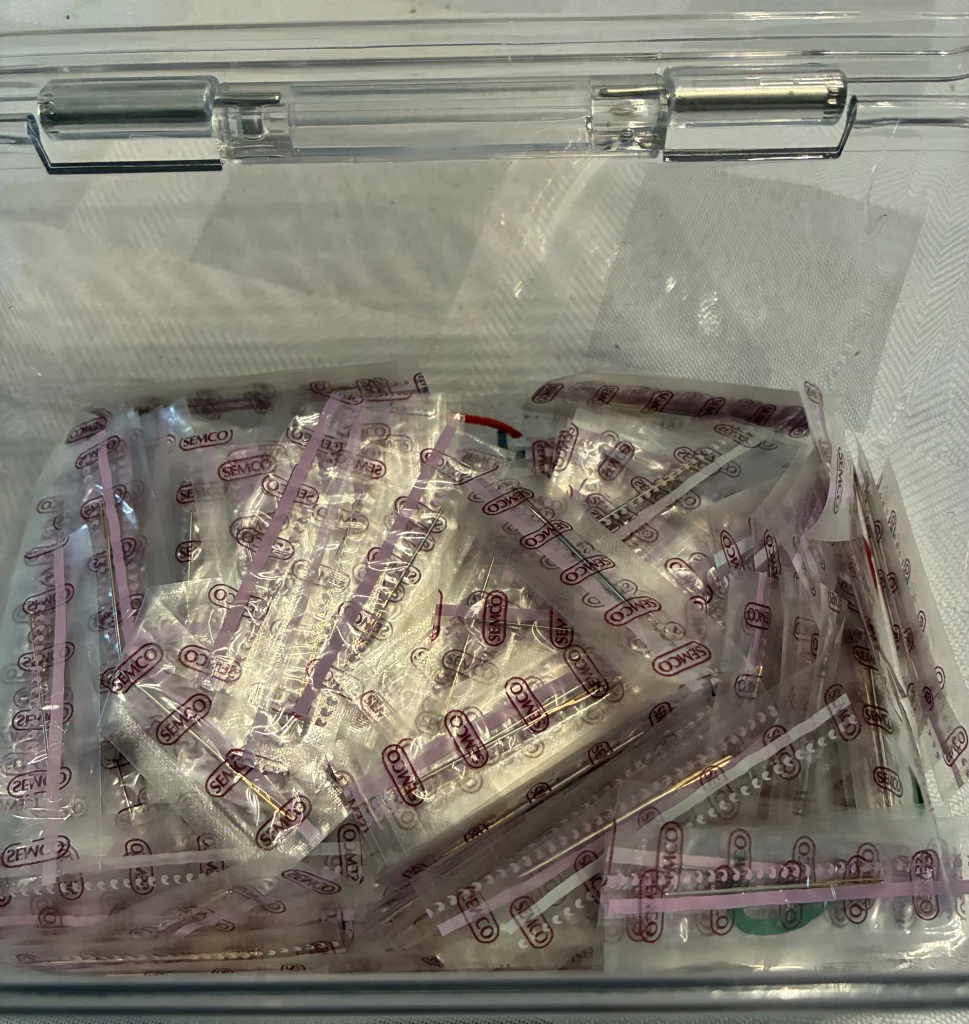
I’m down to a few hundred now, and since I swap out a needle roughly every 30 or 40 hours of stitching, this box isn’t running out any time soon. (I unwrap about 10 at a time and they live in my needle case. The box is just the warehouse.)
Frequently Asked Questions
What size needle for 14 count Aida?
A size 24 tapestry needle is the standard choice for 14 count Aida. It slips through the holes without stretching them and its eye takes two or three strands of floss comfortably. If it feels chunky in your hand, a 26 works too.
Can I use an embroidery needle for cross stitch?
You can, but it will fight you. Embroidery needles (sharps and crewels) have pointed tips designed to pierce fabric. On Aida the point catches the fabric threads instead of sliding through the holes, which makes wonky crosses and frayed floss. A blunt-tipped tapestry needle is the right tool.
Are tapestry needles sharp?
No. Tapestry needles have a rounded, blunt tip. They’re designed to slide through the existing holes in Aida and evenweave fabrics rather than pierce the threads. That’s what makes them right for cross stitch, and it also makes them harder to prick yourself with.
What’s the difference between a darning needle and a tapestry needle?
They’re close cousins. Both have blunt tips and large eyes. Darning needles are generally longer and thicker, made for mending with yarn. For cross stitch floss and fabric counts, a tapestry needle is the better fit, though in a pinch a fine darning needle will do the same job.
When should I replace my cross stitch needle?
When it goes dark or rough, when it snags your floss, or when stitching starts to feel like more effort than it used to. Skin oils gradually corrode the plating on standard needles, so how long one lasts varies a lot from stitcher to stitcher.
Do gold-plated needles make a difference?
Yes, especially if your skin tarnishes ordinary needles quickly. Gold plating reduces friction so the needle glides through fabric, and it resists corrosion far better than nickel. Titanium-coated needles last even longer. Neither is essential for beginners, but both make stitching noticeably smoother.
What to Look at Next
Now that you’ve got more information on the right needle for your fabric, you might like to:
- Learn how to prepare your fabric for cross stitch, including edge finishing and finding the centre
- Go back to the Beginner’s Guide to Cross Stitch for a clear overview of tools, fabric, thread, and how everything fits together
- Or, if you’re already planning a project, choose your first cross stitch pattern with confidence


Leave a Reply