
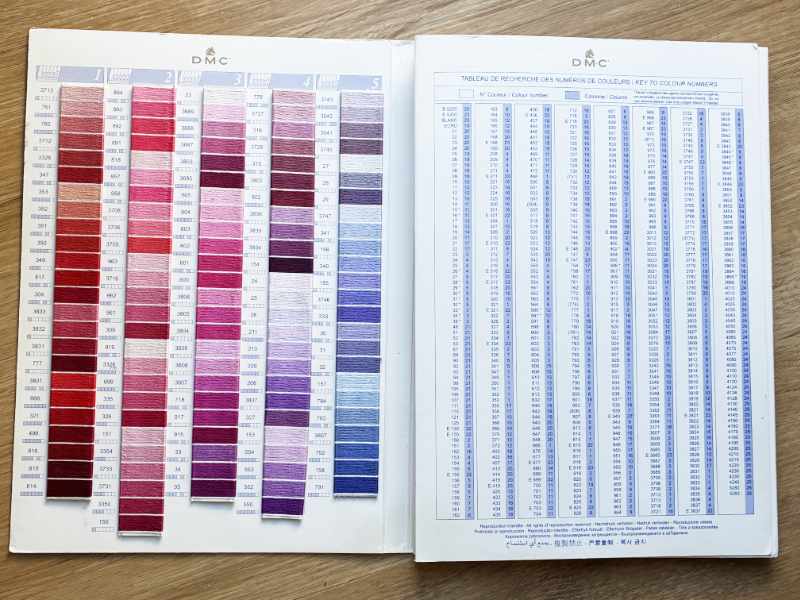
Somewhere around the thirty-skein mark, you realise you’re spending your precious stitching time scratching through your pile of embroidery floss to find the colour you need. The shoebox has become a tangle, and in there you find a second skein of a colour you bought a couple of months ago because you didn’t remember you already had it.
So you decide: got to organise this. You already know there are gaps in the numbering of DMC and other brands. The real question is colour order or number order? And the answer depends on what you prefer, and how your brain works.
The three ways stitchers store their floss
There are really three states a floss collection can be in.
The first is where most of us start: the shoebox, the plastic bag you brought the floss home in, the drawer you rummage through. It works fine for a handful of skeins but chaos grows along with your stash.
Every stitcher has been there so you’re not behind. The other two are:
- number order
- colour order.
Before you pick one, note that the order is a separate question from the storage method. If you haven’t yet decided whether you’re a cards person, a sleeve person, a harp person, or a bobbins person, start with our guide to floss storage methods and come back once you’ve settled that. This post is about what happens next: how to sequence the colours once you know how you’re storing them.
This is the great divide of floss organisation, so let’s settle it properly. Vote below and see which team is winning. ;)
The case for number order
Number order means your floss sits in the same sequence DMC assigns it, from 1 to 5283.
Its big advantage is that the rest of the cross stitch world already speaks this language. Pattern thread lists are usually written in number order. Shopping lists are in number order.
When you sit down to kit up a new project, you run your eye down the chart’s list of numbers and check them straight off against your collection in the same sequence, no hunting. If you’re working towards a full DMC set, number order shows you the gaps at a glance, because a missing number is an empty slot in an otherwise unbroken run, which is exactly what a thread tracker or inventory list is built to catch. And when you’re standing in the craft store with your shopping list, number order is usually how you find the colour you’re looking for.
It’s the practical, list-driven choice. If the way you stitch revolves around patterns, shopping lists, and building a complete set, number order keeps you in step with all of them.
The case for colour order
Colour order means your floss is arranged the way your eye sees it: the reds together, the blues running from palest sky to deepest navy, the greens grading through sage and olive and forest.
The case for it is partly that it’s a thing of beauty and a joy to use. But it’s also genuinely more practical for certain jobs. When you reach for “that soft dusky sage” rather than “524”, colour order puts your hand on it without a number lookup.
When you want to swap a shade in a chart, or turn a pink flower purple, you need to see the neighbouring shades side by side to choose well, and colour order lays them out for you.
The same is true when you’re blending or tweeding, choosing colours that sit well together.
But what’s best?
Is there a best? We think it’s what you prefer, what works for your own brain and eyes.
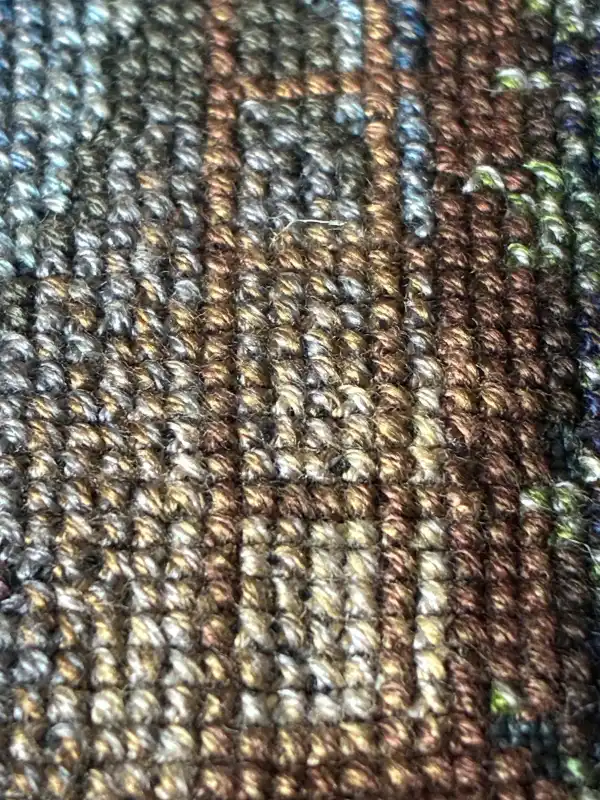
But, DMC’s own colour card, the lovely (and pricey) one with real thread snippets that all designers use and many stitchers covet, is arranged in colour order, not number order.
The company that assigns the numbers still chose to display its threads by colour when it built its reference.
BUT they didn’t abandon numbers. The card has a number index showing where each colour sits, so you get the visual layout with a lookup path back to the numbers. Best of both worlds, in other words, and a fair hint at where the convenience really lies.
So which one suits you?
Before we get into it, declare your allegiance. Every stitcher sorts their floss one of two ways, or has a bag/box and good intentions. Vote below and the tally will show you where everyone else stands.
Neither order is right or wrong. Most of us lean one way without ever having put it into words. If you’re still not sure, this quick check might help:
| Your situation | Number order | Colour order |
|---|---|---|
| You’re working towards a full DMC set | ✓ | |
| You’re kitting up a new pattern from its thread list | ✓ | |
| You want to check what you own against a pattern | ✓ | |
| You shop to a thread list at the craft store | ✓ | |
| You reach for “that soft sage”, not “524” | ✓ | |
| You want to swap a shade in a chart or match a new colour to it | ✓ | |
| You’re blending or tweeding and choosing shades that sit well together | ✓ | |
| You mostly stitch from your stash, not to a shopping list | ✓ |
If you ticked mostly down the left, number order is your system. If you ticked mostly down the right, colour order will feel like home.
And if you landed somewhere in the middle, you’re in good company, that’s what DMC does too :)
The tools, in whichever order suits you
We make our printable floss organising tools in both orders, because stitchers genuinely split on this and we’d rather you had the one that fits the way you work.
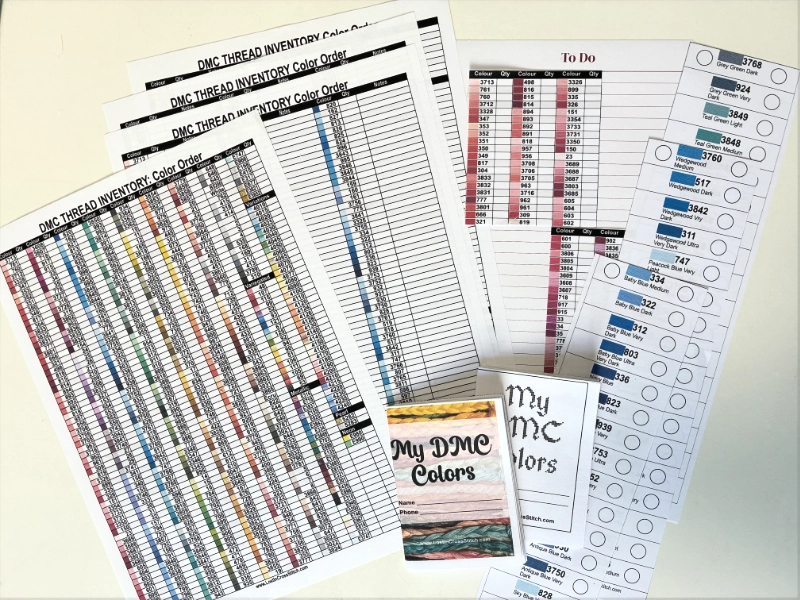
- The Single-Page Floss Inventory gives you the whole collection on one sheet for a quick check at a glance, in your preferred order.
- The Three-Page Floss Inventory adds room for notes, for stitchers who like to track a little more detail.
- The Floss Planner Stickers are super convenient if you’re a planner lover. The small pages stick right into your planner and you can even cut them into strips.
- The DMC Floss Inventory Mini Book is the pocket-sized one you carry to the craft store to mark off what you own and spot what you’re missing.
- Floss Organiser Cards keep your threads in long, ready-to-use lengths, with a card for each colour. Available in number order and colour order.
Every one is an instant download, ready to print at home, and updated to the latest DMC floss chart (2023). There is space for you to add any discontinued floss colours you might own.
Note that printed colour swatches are a faithful guide, but every printer renders colour a little differently, and ink on paper will never be a perfect match for dyed thread. Treat a printed colour reference as a strong guide rather than an exact match, and you won’t be caught out.
Get it sorted, and get back to stitching
The order you choose matters far less than choosing one and sticking with it. Once your floss has a home and a sequence, every project starts faster, the duplicate-buying stops, and you spend your stitching time stitching rather than searching.
If you’d like the bigger picture, our Complete Guide to Embroidery Floss Organisation pulls together everything from first sort to full collection, storage to tracking, in one place. Then pick your order, kit up, and enjoy getting happily lost in cross stitch.



Leave a Reply