

You’ve probably noticed them by now. Cross stitch patterns that look absolutely stunning in the Facebook group or Etsy listing photo, with stunning shading, glowing colour, the kind of image that makes you click “buy” before you’ve really thought about it and maybe you’re starting to wonder: is this a fake cross stitch pattern?
There are a lot of them about lately, and they’re gorgeous, which is exactly the problem.
A good number of these are AI-generated, effectively fake cross stitch patterns, and the thing that makes them so lovely to look at is the same thing that makes them miserable, if not impossible, to stitch.
This isn’t a post about whether AI is good or bad, that’s a much bigger conversation and not ours to settle here, and it isn’t a “never buy these charts” post either. If you fall in love with one of these designs, and you’re happy with the size and the colours and time commitment, buy it and enjoy it. Plenty of people genuinely love a big, full-coverage piece. The whole point of this post is so you know what you’re buying before you buy it, rather than thinking you’ve picked up a quick weekend make and discovering it’s twenty thousand stitches and half of them are confetti.
We’ve been stitching and designing for decades, and we have been wondering what impact these patterns will have on our business. This is how we make a living, after all. We’ve been noticing how often people are asking questions in various cross stitch groups.
And more concerning, we’ve been noticing people posting “this is my new pattern I just finished” and soon a dozen people chime in with “oh wow, gorgeous” comments (people with very ‘thin’ profiles, we’ve noticed). Out of curiosity, we’ve zoomed in and voila, there’s the tells.
But, we bought a couple to see what we were up against, and we tried a couple of AIs to see what they make. Here’s what we learned, so you can spot one before you’ve handed over your money and your precious stitching time.
All nine checks are on a free one-page checklist you can save to your phone or print, so they’re with you when you’re browsing. Jump to the checklist.
What an AI-Generated Cross Stitch Pattern Actually Is
An AI image tool can spit out something that looks like a finished cross stitch piece in seconds. Software then converts that image into a chart, and it gets listed for sale. It looks like a chart. It’s sold like a chart. But a beautiful AI-generated cross stitch picture does not, ever, translate well into something you can stitch, because no one who actually stitches placed every stitch.
The thing AI is brilliant at is smooth, photographic shading, those gradients that melt one colour into the next. On a screen it looks incredible.
But cross stitch doesn’t work in smooth gradients. It works in stitches of single colours (with one exception we’ll discuss below). So when that gorgeous gradient gets converted into stitches, the only way the software can fake the smoothness is to scatter hundreds of single stitches, one of this shade, one of that, with no blocks to follow. It looks beautiful zoomed out. Up close, it’s confetti.
Almost everything else that makes these patterns slow and probably messy to stitch comes back to that one fact.
If you know what you’re buying before you buy it, you know that you’ve not picked up a quick weekend make.
How to Spot a Fake Cross Stitch Pattern Before You Buy
1. Zoom right into the shading
Zoom into any shaded or curved area of the listing photo.
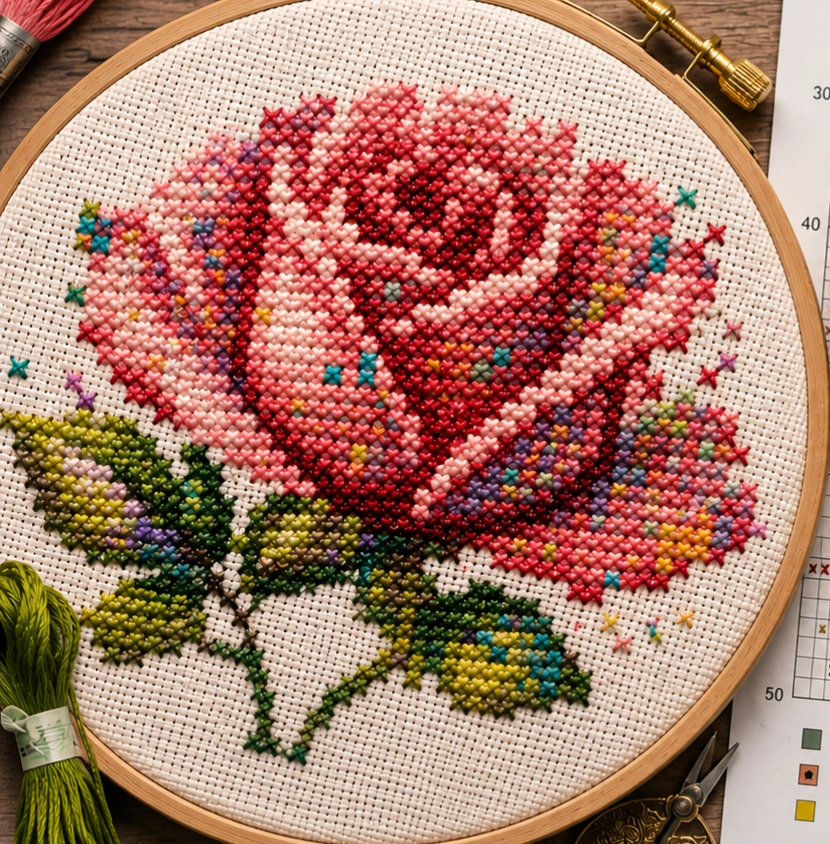
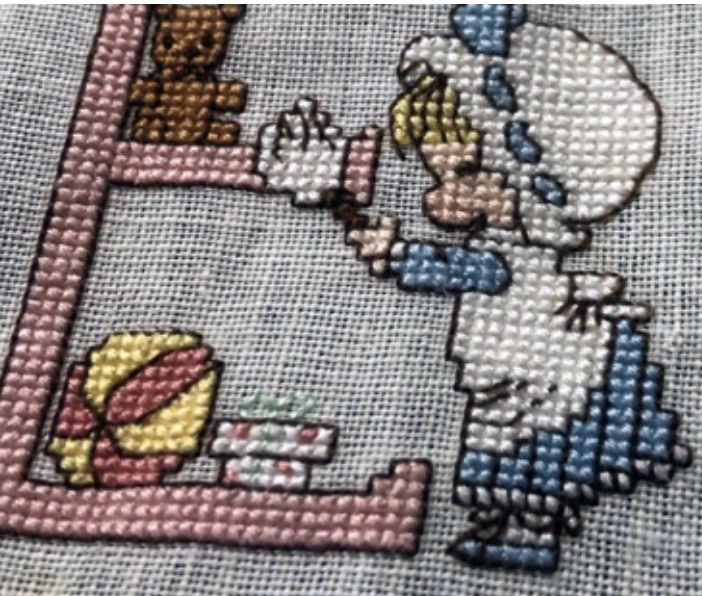
Real cross stitch colours step into each other over a few rows or columns. If the shading you’re seeing has more than one colour in a single stitch, it’s very likely you’re looking at an AI-generated cross stitch pattern. You’ll also see truly weird filler stitches – not 1/2 or 1/4 stitches, rather some odd mix. We could have circled hundreds more stitches in this image.
Even the fabric looks strange.
2. Check the colour count
Faking those smooth gradients takes a lot of shades. If a fairly simple subject calls for dozens, or well over a hundred colours, ask yourself why. A hand-designed chart uses the colours it needs and no more. A converted AI image often needs an enormous palette just to hold the illusion together.
And, all those shades end up scattered across the design as single stitches, one of this colour, one of that, with no blocks to work from. Stitchers call this confetti, and a whole pattern made of it is slow, fiddly work, constantly switching thread for a single stitch at a time.
Confetti isn’t bad on its own, it can add a real sparkle to a piece. But human designers manage it so it adds the sparkle, not the madness, to the stitcher.
3. Look for full coverage
Lots of AI-generated cross stitch patterns stitch every single square, including backgrounds that could happily be left as bare fabric. Full coverage is sometimes a real design choice that stitchers love, such as the much-loved Heaven and Earth designs, and even some of our own landscapes.
Some AI pattern sellers do remove the background, so this one’s a clue rather than proof. But a piece that fills every square, especially in areas that didn’t need it, is often carrying that gradient logic right across the whole design.
4. Check the size and the stitch time
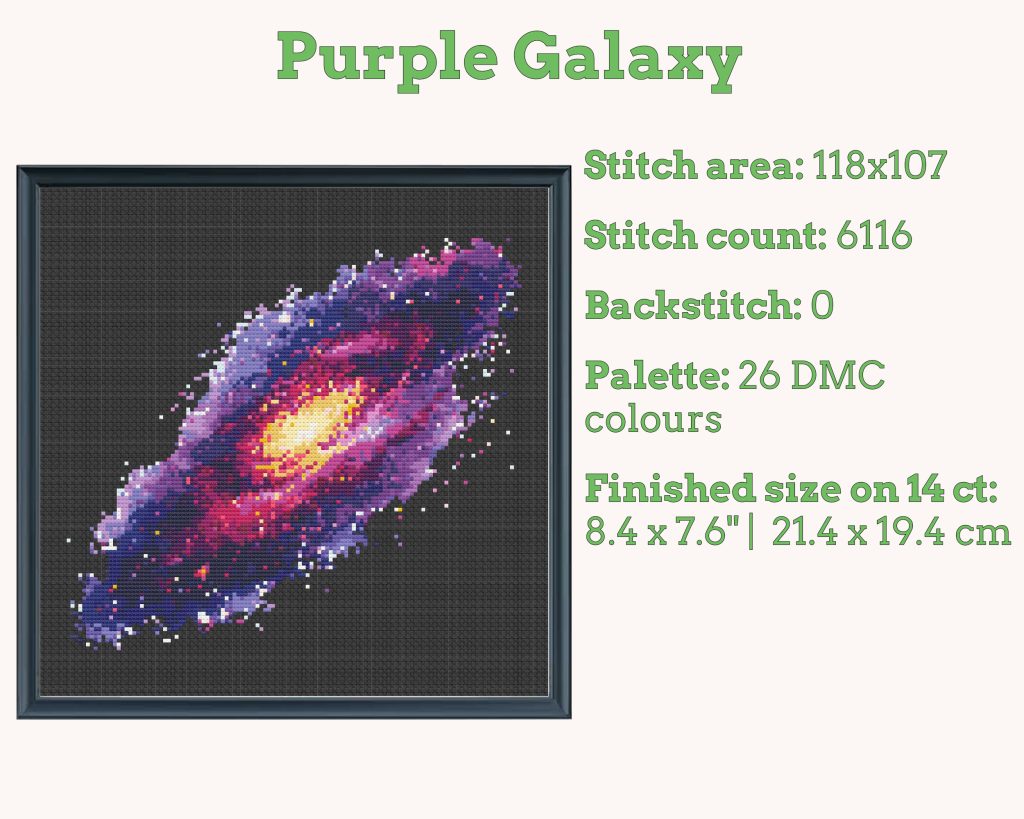
A well-considered pattern listing tells you the stitch count and the finished size, usually across a few fabric counts. We’ve put those on our listings for years, because they’re useful to a buyer.
Two things to watch: if a simple-looking piece runs to tens of thousands of stitches, that’s the gradient tax and you’re signing up for a very long stitch, which is great if that’s what you want.
And if the listing is vague about the numbers altogether, it might be because they’re alarming once you see them written down.
Look for listing images or descriptions that give you the pattern’s stats.
5. Look at the backstitch
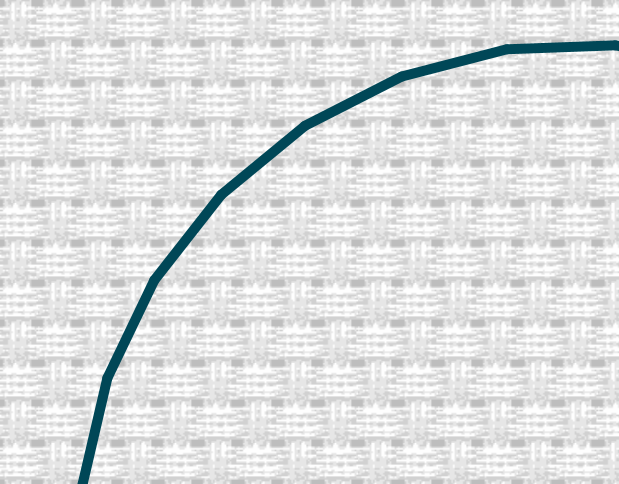
Backstitch on real fabric travels along the grid, so it’s made of short segments that step around the squares, usually with a few angles to it. You can stitch one over two or one over three to smooth a line out, but long, smooth, sweeping backstitch curves aren’t really stitchable. If the outlining flows like a pen drawing and ignores the grid entirely, that’s a drawn line, not a stitched one.
A good quick test: look for a backstitched circle in the design. You can’t stitch a truly round circle in backstitch, it will always have little flat steps where it follows the grid. A smooth, perfectly round circle is a giveaway that an AI designed it.
6. Look for things that make no sense
This one is about the picture itself, not the stitching. AI is notoriously bad at small details, so look for an extra finger or two, a cat with an odd number of paws, a paw or ear that melts into the background, a face that isn’t quite right.
And if there’s any lettering, read it. AI often produces text that looks like real words at first but when you actually try to read it, it’s alien gibberish. A wonky hand or a nonsense word can tell you immediately. Most cross stitch text will have at least some backstitch. AI text will be in cross stitch, with speckled shading around it.
Of course, this might improve over time so depending when you’re reading this, it might no longer apply. But at time of writing (2026) we’re 3 years into the AI Revolution and it definitely still applies.
7. Read the reviews closely
Look for actual verified shop reviews, not “ooh lovely” comments under a photo in a Facebook group.
And be fair about it: only around one in ten buyers ever goes back to leave a review, so a newer or smaller listing won’t have many, and that on its own means nothing.
What you’re after is whether the people who stitch the patterns in this shop thought they were stitchable and gave a result that was close to the listing images. If they enjoyed it, and were delighted enough to post a pic of their own finish, even better.
Only a tiny fraction of people who leave reviews, add photos. So you won’t see them on every review.
8. Look at the size and freshness of the whole shop
One person can only hand-design so many patterns. A young shop with hundreds of wildly different, highly detailed designs, all appearing in a short space of time, is worth a second look, because that’s more than two hands can physically do.
The exception is a shop with a team of designers, or an established craft retailer carrying many named designers, which is perfectly fine.
But if a shop is a year old with 1000 patterns, take a few minutes to look much closer.
9. Check whether the symbols are distinct
If the listing shows you a chart preview of that pattern, look at the symbols. On a well-made chart they’re carefully chosen to be easy to tell apart. Of course they can’t show you the whole chart because if they give away the chart, they don’t have a business. But a chart with a huge colour palette can be a mass of similar-looking symbols, which can make your eyes bug out, even when everything else is fine.
One thing that’s not a red flag
A software-generated preview image is not the same as an AI-generated pattern.
Almost every designer uses charting software, including the big names like DMC. Software makes a neat representation of the finished piece, and yes, if you zoom into one of those you’ll see computer-rendered stitches. That’s completely normal. It’s not the enemy.
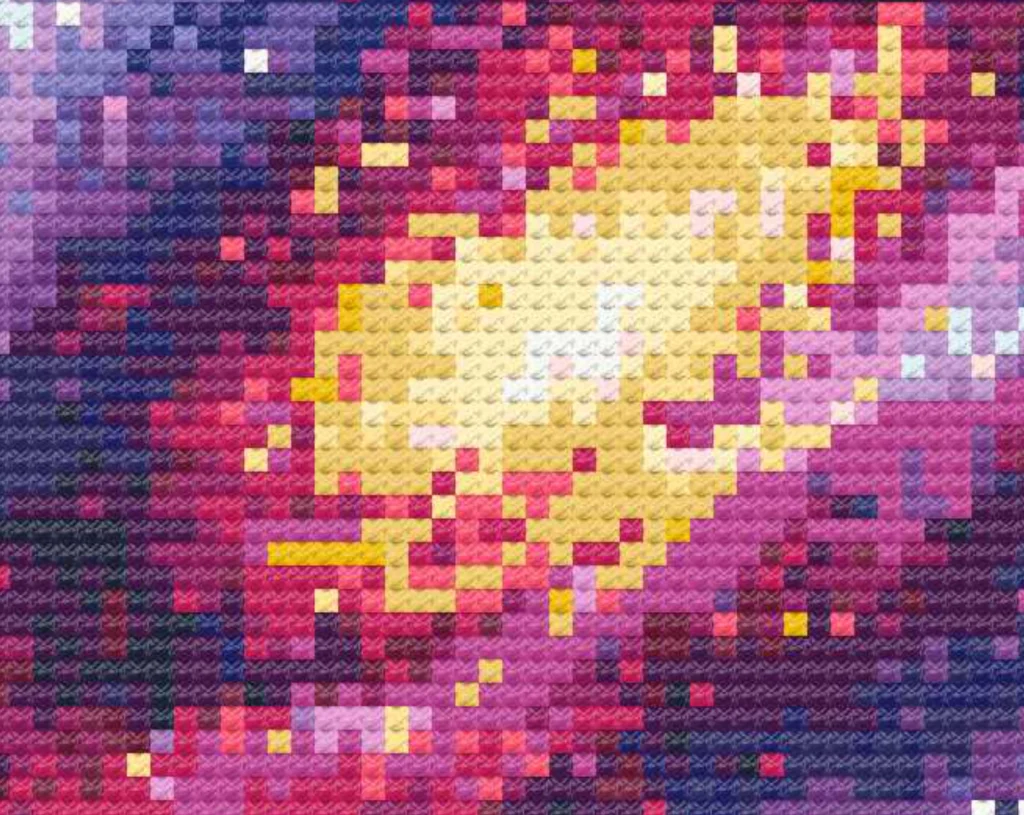
The difference is the colour of the stitches. With a real chart, a person has placed every single stitch by hand, chosen the palette, kept the confetti under control, checked the grid, and the software is rendering that human work as single-colour stitches.
So a software preview of a real, hand-charted design is not a fake cross stitch pattern. A converted AI image sold as a chart is.
The exception we mentioned at the beginning
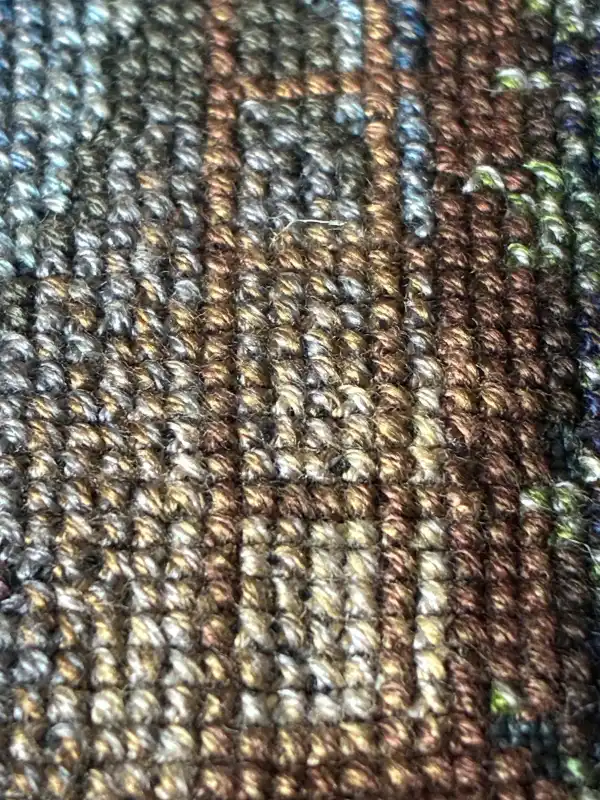
The exception is with what’s called tweeding. This is where a strand of two different colours are stitched together. But then you’ll be able to see the two different colours, laying side by side, on each stitch. An AI-generated image will have a stitch where, in a single stitch, two or more colours kind of wash over the stitch.
A word about our own patterns, since it’d be fair to ask. We place every pixel by hand. We stitch many of our patterns ourselves, though not all of them, because there’s only two of us and we’re running a business that takes a lot of hours.
A chart being real has never been about whether it was physically stitched. It’s about whether a human who is a cross stitcher designed it, stitch by considered stitch.
The Shortcut: Buy Cross Stitch Patterns You Can Trust
We get it, no one wants to run a forensic investigation on every $4 pattern when all you want is to pick something pretty and get on with your next stitch. We’re not suggesting you squint at every listing for the rest of your life, or stop buying patterns online because it’s too hard to trust your own eyes.
What we are suggesting is learn what a well-made chart looks like once, get a feel for it, and then you can stop checking everything and just buy from designers you’ve come to trust. Find a few makers whose charts you know are sound, and the squinting stops. Knowing the tells means you’ll know good work when you see it, so you can get back to enjoying the part you actually came for.
Our guide to cross stitch patterns for beginners includes a few quick checks to run before you buy.
As we said earlier, these tools are getting better all the time, so some of the tells in our checklist won’t hold forever. The gradients and the weird stitches and the impossible backstitch give things away today, but a year or two from now the giveaways might be different. They might even do away altogether! But this is where things stand right now, and we’ll update it as things change.
If you’d like a place to start, everything in our shop is charted by hand, by the two of us, stitch by stitch. We keep the confetti under control and choose every palette on purpose, and we’d love for you to come and have a look.

Patterns charted by hand, stitch by stitch
Every pattern in our shop is charted by the two of us, with every colour chosen on purpose and no confetti for the sake of it. Our landscapes are a good place to start, from desert lookouts to starry skies.
Use code REALPATTERN at checkout for 10% off your order.
Your free checklist
We’ve put all nine checks onto a single page you can save or print, so the next time a too-good-to-be-true pattern catches your eye, you’ve got the list to hand. No sign-up, no catch, just download it and keep it with your stitching.
Before you buy floss for your next pattern, check what you already have. Our DMC floss mini book is a pocket-sized inventory of every DMC colour: tick off what’s in your stash, tuck it in your project bag, and stop buying the same skein twice.
We’d love you to leave a comment to let us know your thoughts on this issue, and the checklist.
Happy stitching, and may all your patterns stitch out exactly as you expect.


Leave a Reply