
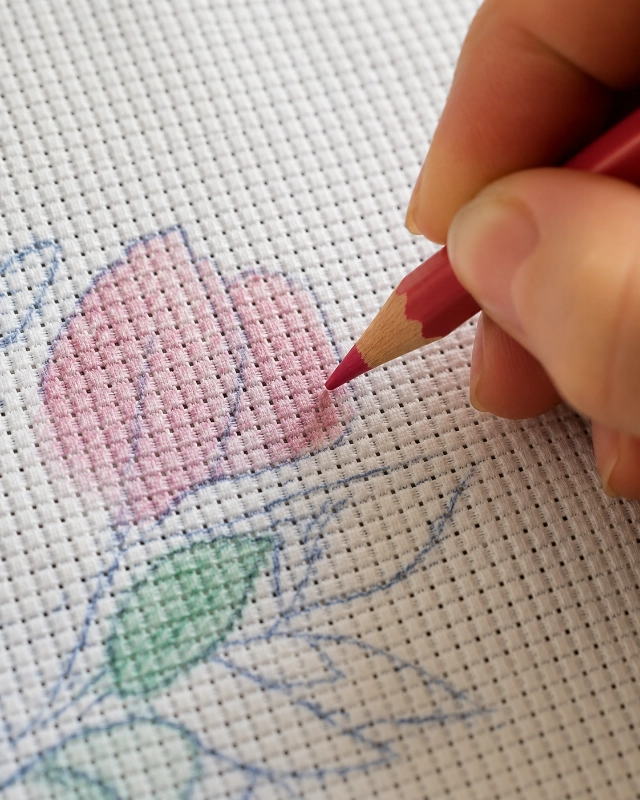
Short answer: Yes, you can colour your Aida before cross stitching, but we don’t recommend it. We looked at the trend, asked our readers what they thought, researched the risks, and found alternatives that give many of the same benefits.
This “paint-by-numbers cross stitch” trend has exploded on TikTok, where videos of stitchers colouring every square before stitching have attracted hundreds of thousands of views.
Fans say it makes charts easier to follow, since every square already shows you which colour lives there, and that it stops white fabric peeking through on full-coverage pieces. Sceptics have thoughts about what pigment might do to fabric and floss.
We have opinions too. But before we share them, we’re really interested in yours. Take this quick poll (It’s completely anonymous) and after you submit you’ll see what others have said.
We asked our email community what they thought, and did a roundup a few days later. We think this is a conversation worth continuing, so please add your vote to the poll and your comment to the post (at the bottom of this page).
The Poll Results
58 readers voted in our poll. Most responses arrived within the first 24 hours, showing there’s plenty of curiosity about the idea. While it’s not a scientific survey, it gives a snapshot of how our community feels about the trend.
Where the needle landed:
- Not on my Aida: 48% (28 votes)
- I’d never heard of it until right now: 33% (19 votes)
- Haven’t tried it, but I’m tempted: 14% (8 votes)
- I’ve tried it, with mixed results: 3% (2 votes)
- I do it, and I love it: 2% (1 vote)
The poll will stay open (July 2026), so these numbers will grow over time. We’ll come back and update the results as more stitchers share their thoughts.
So half of our readers want to protect their Aida, a third met the trend for the first time, and only three have actually put pigment to fabric.
Our Verdict
The comments told the richer story.
- An 80-year-old stitcher tried it on small bookmark kits and liked it: “I find it harder to keep my place on a pattern, especially a larger one with lots of color changes… for a small project, it was great.” She also found “some colors on the cloth were harder to determine what color floss to use,” which we’ll come back to.
- One of you marks with washable and heat-removable pens but hesitates over pencils “for fear of the inks smearing while washing the piece.”
- Another raised a problem I hadn’t thought about during all my watching: “I might change my mind on a colour and if I’ve coloured it in then I’m stuck.”
- Several of you had the same verdict about effort: “If you color it in and then cross stitch on top of that, you have done the work twice.”
Down in the comments below, Joyce agreed (“a lot of extra work and time when I could be stitching”) and Maria put the whole thing in words that deserve framing: “Do not make stitching more complicated; there’s enough trouble in the world already.”
Your objections sorted into three camps:
- It doubles the work.
- It takes the craft out of the craft.
- And it risks the fabric.
What struck me is that the third camp was by far the smallest. Almost nobody raised the thing that worries me most, so let me make the case nobody made.
Cards on the table before I do: I haven’t tested this myself, because I wouldn’t risk a project on it. But the videos kept appearing in my feeds, so I went down the Reddit, TikTok and YouTube rabbit hole on your behalf. Here’s what I found.
What Is Paint-by-Numbers Cross Stitch?
A few different things get muddled together whenever this comes up, so let’s separate them.
- Stitchers have always made marks on fabric. A dot to note the centre, a basted line, gridding to divide the fabric into blocks of ten so it matches your chart. To my mind, those are small and deliberate navigation aids, and they’re not what this Aida colouring-in trend is.
- There’s also a long tradition of tinting fabric before stitching, where the colour is part of the finished design. John emailed to remind me that a whole company has been built on this, and he’s right.
Meg Hawkey’s Crabapple Hill Studio spent decades selling crayon-tinted embroidery patterns: you prime the area with white crayon, tint it with coloured crayons, then heat-set it with a hot iron through paper towels, repeating with fresh towels until no colour transfers at all. Then you stitch. Her crayon tinting tutorial is still on YouTube and worth a watch. The tinting is the visible art, framed by embroidered outlines, and the method exists precisely because pigment on fabric wanders until you’ve deliberately set it. Hold that thought. - The trend is a third thing: colouring in the entire design on your Aida, square by square in the pattern colours, then covering your colouring completely with crosses. The colour isn’t decoration. It’s a counting aid that’s supposed to disappear under the stitching. In effect you’re manufacturing your own stamped cross stitch kit, using pencils and markers.
Why people love it
The impulse is completely legitimate, and our 80-year-old commenter is the proof. She finds it harder now to keep her place on a busy chart, she tried the colouring on small bookmark kits, and for a small project it genuinely helped. Easier on tired eyes, fewer counting errors in low light, a gentler on-ramp for beginners, and handy for take-along projects where you’d rather not juggle a chart on a plane.
Stamped kits have existed for generations for exactly these reasons. Nobody colouring their fabric is being silly. They’re solving a real problem with the tools in the desk drawer.
The question (dare I say problem) is what those tools do next.
The Risks of Colouring Your Aida
Think about what a cross stitch actually is: two passes of floss dragged firmly across the same square of fabric. Now put pigment in that square. Every single stitch hauls your thread over the colour twice, under tension. You know how your floss changes texture as you stitch, gets a bit thinner or fuzzier (depending on the colour). It’s just friction doing what friction does, as we all learned in basic science. I can only imagine that it’s also picking up pigments from the colouring tools.
Then the pigment that stays behind gets sealed in. Once the crosses are on top, no gentle hand-wash reaches under them, so whatever the pencil or marker left in the fibres is there for the life of the piece. “Water soluble” on the packet means it dissolves in water, and plenty of stitchers have learned the hard way that it doesn’t mean “comes out of fabric on request.”
Textile conservators will also tell you that inks and dyes not designed for fibre can yellow, shadow, and weaken threads over years, long after the piece is framed.
So that’s my main issue with this technique. And your comments added two problems I hadn’t thought of:
- Colouring commits you: change your mind about a colour halfway through, as one of you pointed out, and you’re stuck stitching over your old decision or starting again.
- And the transfer itself is a chance to go wrong. One reader grids with monofilament and noted that copying a chart onto fabric is exactly where miscounts creep in because we’re only human, and cross stitch often makes us wonder if we can actually count ;).
And then there’s the colour key problem, which our bookmark stitcher hit head on: “some colors on the cloth were harder to determine what color floss to use.”
Unless your design is a handful of high-contrast colours, you need a pencil to match every floss shade, or a translation key mapping pencil colours to floss numbers. I don’t own four shades of dusty rose in pencil form, do you?
At that point you’ve rebuilt the counting problem you were escaping, with extra steps. The viral videos are almost all bold, low-colour folk motifs, which is the best case for this technique, and the videos don’t mention that.
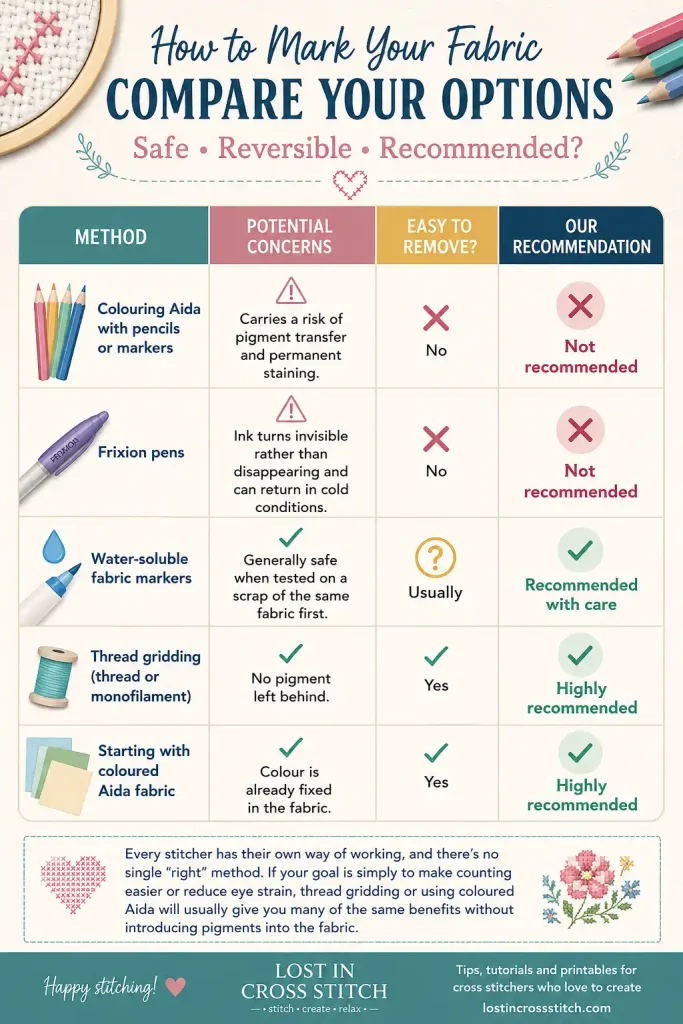
If you’d rather skip to the practical takeaway, here’s how the different options compare.
| Method | Potential concerns | Easy to remove? | Our recommendation |
|---|---|---|---|
| Colouring Aida with pencils or markers | Carries a risk of pigment transfer and permanent staining. | No | Not recommended |
| Frixion pens | Ink turns invisible rather than disappearing and can return in cold conditions. | No | Not recommended |
| Water-soluble fabric markers | Generally safe when tested on a scrap of the same fabric first. | Usually | Recommended with care |
| Thread gridding (thread or monofilament) | No pigment left behind. | Yes | Highly recommended |
| Starting with coloured Aida fabric | Colour is already fixed in the fabric. | Yes | Highly recommended |
Every stitcher has their own way of working, and there’s no single “right” method. If your goal is to make counting easier or reduce eye strain, thread gridding or using coloured Aida can give you many of the same benefits without introducing pigments into the fabric.
One option deserves its own section…
Why We Don’t Recommend Frixion Pens
I’ve used Frixion pens on sewing projects and found the colour difficult to remove completely. When I researched how to fix it, I found that the quilting world has already run this experiment at scale.
Frixion ink doesn’t disappear when you iron it. It turns invisible.
The pigment is still in the fabric, and when the weather turns cold, it comes back.
Quilters have shipped competition quilts by air and had every single marking reappear at the show, courtesy of the cargo hold.
Some fabrics also keep a permanent ghost mark where the ink was, visible at certain angles forever.
The Pilot Frixion pen is genuinely lovely. I still use mine when bag making because it gives such great precision, but only when the marks will be inside the seam allowance.
Pilot has never claimed the pen was designed for fabric, because it wasn’t.
If a marking tool’s whole party trick is “the marks vanish,” ask where they went. And if they’ll stage a second coming.
A middle path: the dot method
If the low-light, keep-your-place benefit is what tempts you, here’s the version I’d actually consider: a small dot of colour at the centre high point of each square, instead of colouring the square in. The centre of the square is where your cross crosses, so the dot ends up buried under the densest part of the stitch, and you’ve put a fraction of the pigment on the fabric.
Seems to me this would give most of the benefit, much less of the risk.
I still haven’t tested it, and if I do it’ll be on scrap Aida or a project that I don’t expect to have around for years, which is exactly how I’d suggest you try it too.
If you want to mark your fabric, use these instead
For marking that’s meant to disappear, the boring tools are boring because they work:
- Tailor’s chalk can brush away.
- A proper water-soluble fabric marker, tested on scrap from the same cloth first, washes out. I have wondered how well that works if you leave it in the fabric for a long time. (Multiple WIPs, anyone?)
- Thread gridding, with sewing thread or monofilament like our commenter uses, lifts out without leaving anything behind at all.
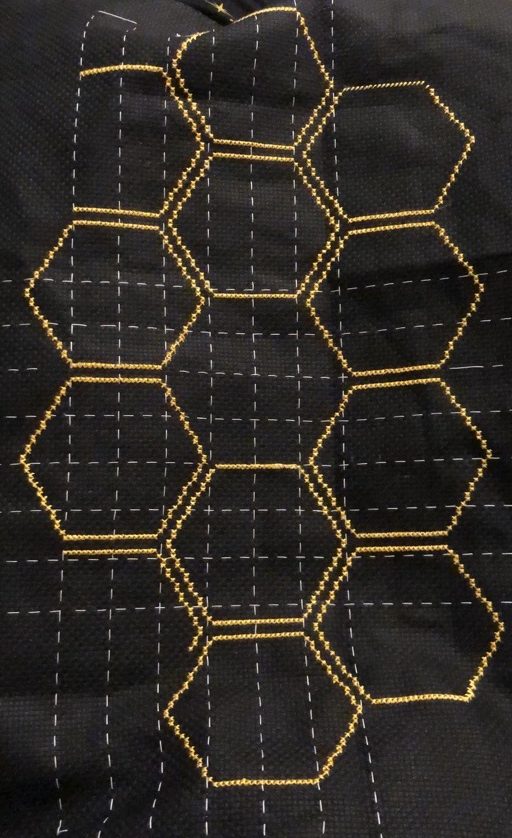
And if what you’re really after is fabric that isn’t white, that problem was solved long ago: as one of our commenters put it, “choose an alternative colour aida!!” Buy hand-dyed from the dyers who do it beautifully, and the colour is fast before it reaches you.
If what you love is the colour-mapping
Here’s where I hand the verdict to three of you who never met and said the same thing:
- “I color a copy of the chart using colored pencils. I would never on the fabric. My method is a lifesaver for complicated patterns.”
- Joyce, in the comments: “I could see coloring the printed, enlarged pattern to better see the design.”
- And a third of you draws on paper and stitches on Aida.
Colour the plan, not the cloth.
You get every bit of the paint-by-numbers clarity, your pigment never comes within arm’s reach of your floss, and you can change your mind with an eraser.
If you don’t want to sacrifice a printed chart, that’s what our cross stitch grid pages are for: print, colour to your heart’s content, stitch from your marked-up copy. There’s also a bound graph paper book on Amazon for those who like a spiral under their hand.
Your turn again
The poll was anonymous, but the comments below aren’t, and they’re open. If you’re happy to put your name to your vote, comment where you landed, and if you’ve tried colouring your fabric, how it went. We reply to every comment.
Frequently asked questions
Does colouring Aida damage your floss?
It can. Every cross stitch drags your floss across the coloured square twice, under tension. Floss picks up loose pigment as it goes. Pigment sealed under finished stitches also can’t be washed out later, and inks not designed for fabric may discolour fibres over time.
Can you colour cross stitch fabric with pencils or markers?
You can, and one corner of the needlework world does it well: crayon-tinted embroidery, where the colour is heat-set until nothing transfers, then stitched over sparsely as part of the design.
Colouring entire cross stitch designs with ordinary pencils or markers as a counting aid is a different thing, and it carries real risks of pigment transfer and permanent marks.
Is it safe to stitch over Frixion pen marks?
We wouldn’t. Heat-erasable ink turns invisible rather than disappearing, and it returns in cold conditions, which quilters have discovered when marked quilts came back to life after air freight. Some fabrics also keep a permanent ghost mark.
Use tailor’s chalk, a tested water-soluble fabric marker, or thread gridding instead.
Does colouring Aida stop white fabric showing through?
Yes, that’s one reason people try it. However, there are safer alternatives such as choosing coloured Aida or using full-coverage techniques. Or, accepting that the fabric showing through can give your cross stitch that unique airy quality so many of us love.


Leave a Reply