
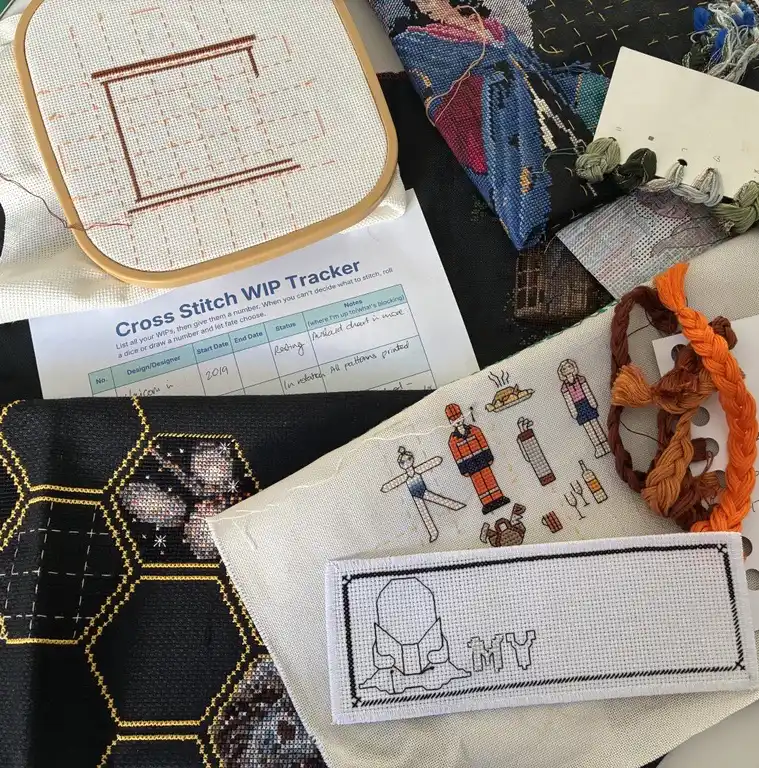
Somewhere in your house right now there are cross stitch WIPs you haven’t touched in months. One in the hoop, a couple kitted up in bags, and the rest in a drawer you’d rather not open in company. I know the state of your WIPs because I have 7 on the go as I write this, so if you were expecting this post to tell you to finish everything before starting anything new… it won’t.
A WIP, for anyone new to the term, is a work in progress: a project you’ve started and haven’t finished. The issue isn’t having them, it’s losing track of them: which floss went with which chart, where you were up to, and why you stopped.
How Many WIPs Is Too Many?
Some stitchers are strict one-at-a-timers. Some run a kind of rotation with two nights on each project in turn. Plenty of us stitch on a whim: whatever looks most interesting tonight is the one we pick up.
That’s my system, such as it is, with one override: when there’s a deadline, the deadline wins. As I write, a milestone birthday gift is priority one every night, no question, and the other 7 sit in my WIPs basket, waiting their turn.
Well, 4 are in the basket, 2 are in a drawer that makes me squint every time I open it. (Linen that I dyed black myself, what was I thinking?) and one is crumpled up in the bottom of my sewing basket, a gift for a one-time friend that’s hung around longer than the friendship did.
Whatever your number, be kind to yourself about it because this is a hobby that can bring so many benefits to our lives.
Guilt has no place.
I reckon that you can choose to see having cross stitch WIPs as part of the hobby, not something to feel guilty about.
Time to share in this little poll. Results show after you complete the poll. (it’s completely anonymous).
Please consider leaving a comment at the bottom to share your WIP story :)
Why We Have Cross Stitch WIPs
I certainly never planned to have more than one stitch on the go at a time. I truly think no one plans to have a drawer where unfinished projects wait in hope.
The WIPS build up for reasons that are mostly good, because projects have different jobs.
Right now I’m picking up my birthday gift piece every evening, but if it were my only project, stitching would start to feel like homework. So the others are the antidote.
Projects suit different moods too: a big piece for a long Sunday afternoon with your new audio book, something small and simple to help turn off your brain for the tired end of a weeknight.
Add a seasonal ornament started in October two years ago, a stitch-along that releases in parts and makes you wait, and one stunning chart you started because you had to see how it worked up, and there’s your 7 (and counting!)
In my life, WIPs aren’t a discipline problem. They’re what it looks like when stitching is part of your life rather than a task on it.
Choosing What to Stitch Tonight
So the WIP list is a great starting point. With my ADHD brain, out of sight is out of mind. My WIPs stay in sight. But a couple of years ago I made the WIP list and came up with status labels for each.
- In rotation
- Resting
- Stalled
- Waiting on supplies
- Done
“Resting” is my favourite, because it’s true: that drawer isn’t full of failures, it’s full of projects having a little lie-down.
Stitching as the whim takes you has a failure mode: the night when every choice feels equal, so you scroll your phone instead of stitching at all.
You could try fixing it by making it a game:
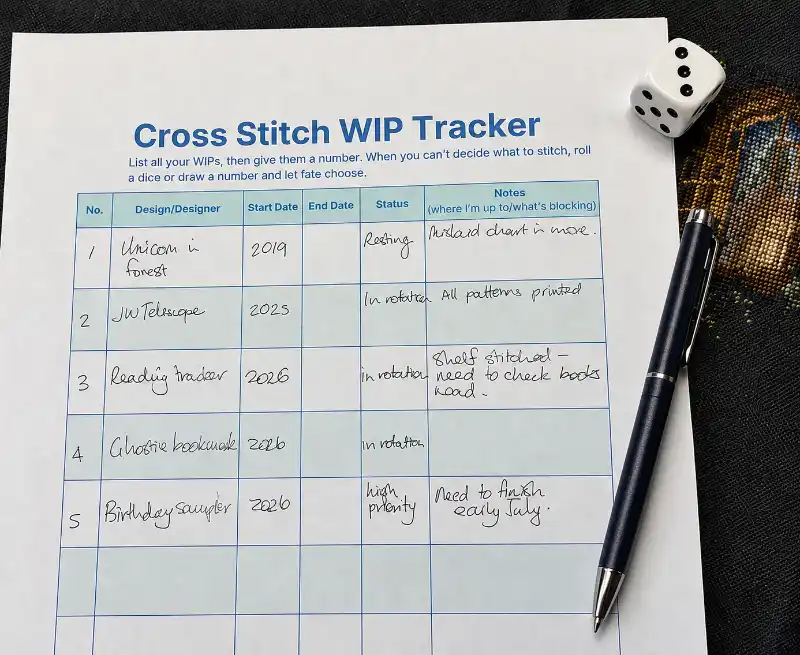
- Give every WIP a number
- Let fate choose. Roll a dice, or use a random number picker on your phone. Or just close your eyes and point.
- Our printable Cross Stitch WIP Tracker Kit has a number column on the tracker page for exactly this.
Or set up a monthly plan ahead of time, and follow it. There’s a handy monthly stitching goals planner in our Cross Stitch Planner.
If you love bingo, Jessie Marie of JessieMarieDoesStuff on YouTube invented WIPGO, where you build a bingo board for the whole year, and stitch by monthly draws.
Setup Every WIP For Success
The WIPs that are more likely to survive months of resting are the ones that are easy to pick up again, where the chart, floss, and fabric are all together in one place. If picking the project back up needs a scavenger hunt, well, it’s another delay.
If you set up every cross stitch WIP as a project, with its own little kit, you’re making it easy for future you. Even if you think this stitch won’t be paused, there’s always the life thing that has a way…
Creating a project kit before you take the first stitch can be that early success step.
And, a gridded piece is much easier to pick up again after months away, here’s how to grid cross stitch fabric.
How to Keep Track of Your Cross Stitch WIPs
Part of the setup can be adding your WIP to the tracker page.
Each WIP gets a line: what it is, when it started, its status, and a note on where you’re up to and what’s blocking it.
When that page exists, no project is a mystery bag again, and coming back after three months away takes minutes instead of an evening of detective work.
A daily stitching log takes it one step further if you like knowing how long pieces actually take, and an annual tracker turns the whole thing into a picture: colour a square for each day you stitch, one colour per project. It’s ridiculously satisfying, and it shows you your real rotation through the year, which might surprise you.
All four pages are in the WIP Tracker Kit, and if you want the full system with stash management and inventories built in, that’s the Cross Stitch Planner.
Where Your WIPs Live
A WIP with a home gets stitched; a WIP in a plastic tangle gets avoided. Project bags solve this, one per project, kit inside, and the whole thing can travel to the couch, the car, or the doctor’s waiting room. We’ve covered choosing a cross stitch project bag that works for you.
The Long-Haulers
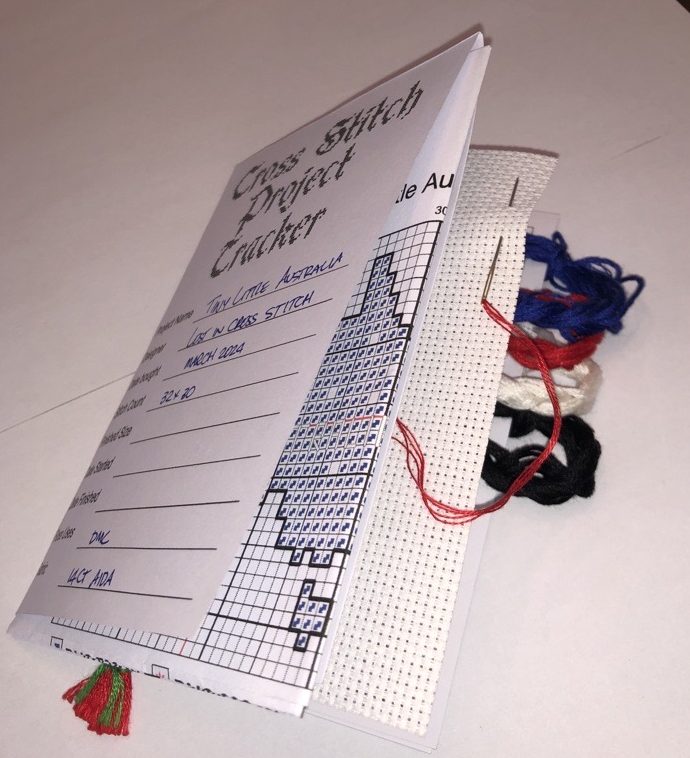
Some WIPs are meant to take a year. Temperature projects, stitch-alongs, and big full coverage pieces live in your rotation for the long haul, and they need a different kind of management: a planned pace rather than a finish line.
If one of those is calling you, start with how to plan a cross stitch temperature project so you actually finish it.
When a WIP Stalls
Every stalled WIP has a reason, and when you know the reason you can fix it.
For me it’s mistakes: I hate frogging even though I’m really good at it, and a project that needs unpicking can rest for a very long time before I face it.
If that’s you, we’ve written about what to do when you’ve made a cross stitch mistake and the gentle art of frogging. I am convinced that cursing is not optional here!
Confetti patches stall me too, those sections where every second stitch is a different colour, which is why I avoid confetti-heavy charts and why we design ours with confetti kept firmly under control. One my my current WIPs is a SAL with confetti central (star systems, of course).
And then there’s the shiny new start, the WIP-maker itself. Years of managing my own magpie brain have taught me one rule that works: I don’t buy new patterns while the drawer is full. Yes it’s hard, but downsizing my home three times helped that lesson along.
Your WIP stalls probably have different reasons. But a stalled project isn’t a failure either way; mark it Resting and let the dice skip it for a while.
Getting Them Over the Line
The finish is the point. It’s the whole reason we design small: the joy isn’t just in stitching, it’s in finishing.
When a WIP finally comes off the hoop, our four-part series on finishing has twenty ideas for what it can become:
Get Them Sorted, Then Get Stitching
7 WIPs or 17, the number was never the problem. Making them easy to pick up as the whim takes you is the solution.
Tonight: list them, number them, give each one a status.
That’s ten minutes, and it turns the drawer of unfinished hope into a menu.
Then fate can help you stitch.



Leave a Reply