

A cross stitch planner can make a real difference when your projects, patterns, and supplies are stored across different places. Having a single place to plan and track your projects makes it easier to enjoy your stitching without adding pressure or rigid routines.
When stitching can feel harder than it should
Cross stitching, for me anyway, is a quiet, absorbing activity, but it can start to feel surprisingly effortful when details are spread out. Even when you know what you want to stitch, small points of friction can creep in and slow you down, such as:
- Finding the chart for your part-stitched design
- Checking whether you already have the right floss or fabric
- Trying to remember where you left off last time
- Looking for notes you’re sure you made somewhere.
None of these are difficult on their own, but together they can interrupt the flow of your stitching time. Many stitchers notice this most once they have more than one project on the go (who, me?) or a growing stash of supplies, which is something we talk about more in how I organize my floss.
Planning helps you get to the stitching faster
When your projects are planned ahead of time, the barrier to starting gets much lower. You’re not spending the first part of your session working things out, you’re already ready to stitch.
Planning ahead helps remove the small delays that quietly eat into stitching time:
- Fewer decisions at the start of a session
- No stopping to check notes or supplies
- Easier re-entry after time away from a project
This can be helpful if you tend to stitch in short sessions or fit stitching around other responsibilities.
Tracking gives you a way back in
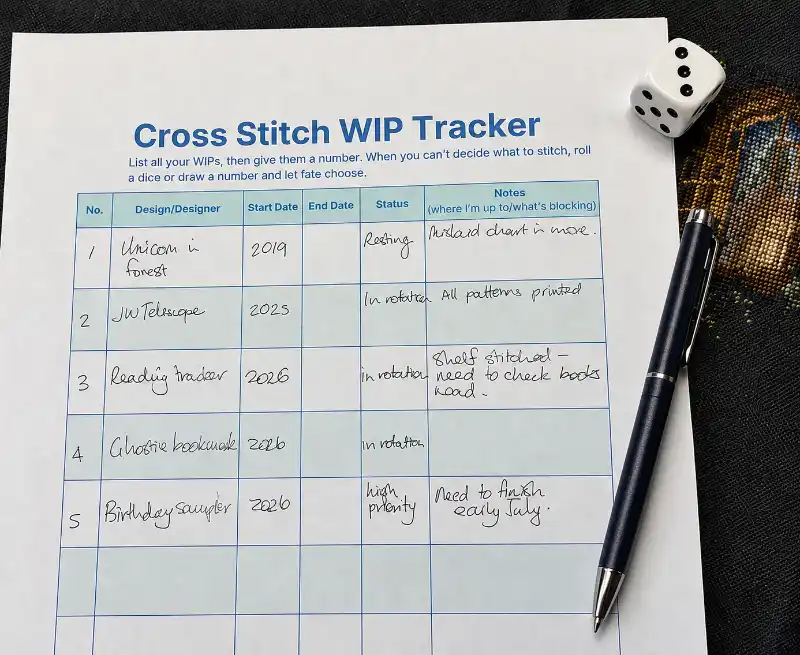
Many stitchers step away from projects from time to time. Life gets busy, energy shifts, or you just need to stitch something different for a while. If you make a quick note in your planner, when you pick up the project again, you can see where you left off and what you planned next. You’re continuing, not restarting.
Larger or long-term projects, including things like temperature projects or multi-part designs, really benefit from this.
Finishing feels more satisfying when progress is visible
Finishing a cross stitch project is about more than the last stitch. It’s the feeling of completion, of seeing something through. When you write down your progress, you can estimate more accurately when you’ll finish. I love anticipating that finished piece, whether it’s framed, gifted, or finished in another way.
A planner is useful if you’re stitching for relaxation and want to keep things feeling like a choice rather than an obligation.
Writing things down reduces mental clutter
When stitching details live only in your head, they tend to resurface at inconvenient moments. You might find yourself mentally reviewing plans when you’re trying to relax, or worrying you’ll forget something later.
A planner helps by giving those thoughts somewhere to land, including:
- Projects you want to start
- Supplies you’re unsure you already own
- Ideas you don’t want to forget
- Notes you keep meaning to track
Once you write it down, you can let it go from your memory. It could just be me, with my ADHD brain, but I notice that this lighter mental load makes stitching feel more satisfying overall. I have the finish/goal in mind so I can relax a bit more.
Organization saves money and frustration
As your stash grows, it becomes harder to remember exactly what you already have. So it’s easy to buy duplicates of anything because checking the drawers and bags for that one color feels harder than buying again.
Keeping track of supplies helps reduce common frustrations, like:
- Buying floss or fabric you already own
- Pausing a project because something is missing
- Digging through multiple spots mid-stitching
A planner offers structure without pressure
You might worry that a planner will introduce rules or expectations that take the joy out of stitching. In my experience, that only happens when a tool is treated as a ‘requirement ‘must’ rather than a support.
A flexible cross stitch planner works with how you already stitch. You might use only a few pages regularly, return to others occasionally, or skip sections entirely. There’s no ‘right’ way to use it, just use it the right way for you.
Why a printable planner works well for cross stitch
Many stitchers prefer paper tools because you can make notes quickly, change plans easily, and keep everything close to the project itself. This is even better when you’ve got several WIPs on the go!
A printable cross stitch planner lets you:
- Print only the pages you want
- Update or replace pages as your plans change
- Keep everything close to where you stitch
- Avoid screens near fabric and thread
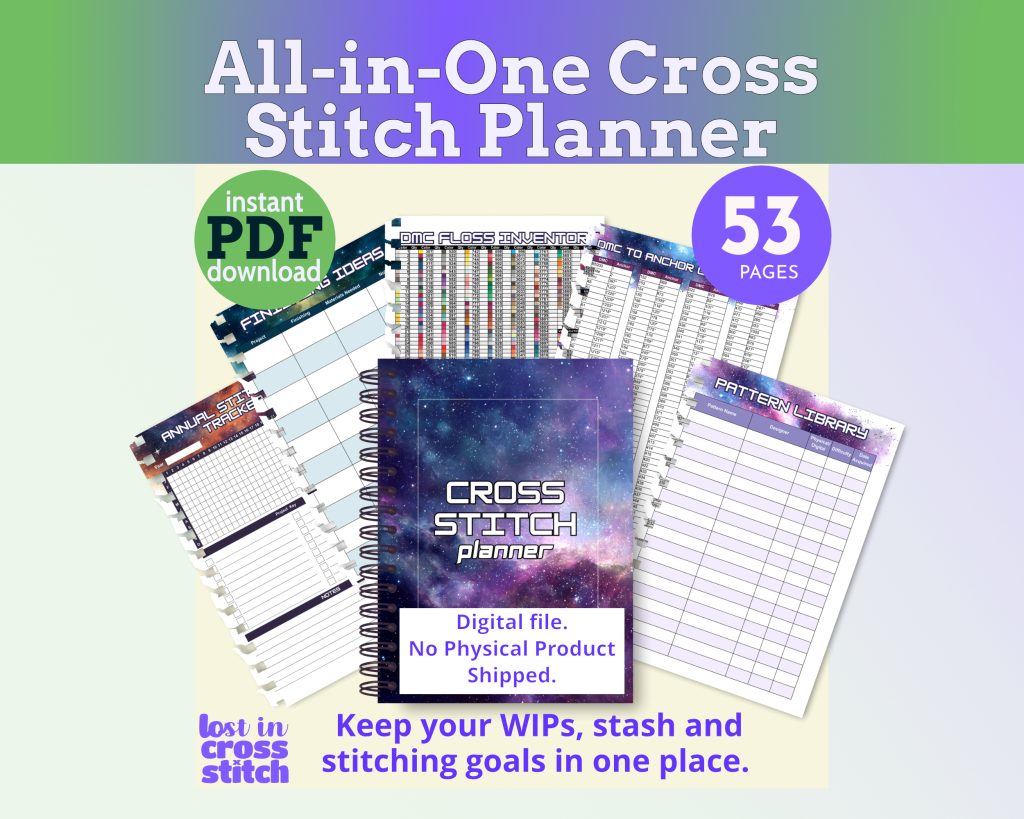
All Lost in Cross Stitch planners are provided in both US Letter and A4, so you can print the size you need at home without resizing or adjusting layouts. And if you like A5 or Half Letter, you can print 2-to-a-page.
You can also explore our different designs of Planners & Trackers.
Choosing a planner style
The pages and layout or our planners are the same across all versions, which means you can choose the aesthetic you prefer without worrying about contents.
Frequently Asked Questions
Do I need to use every page in a cross stitch planner?
No. Most stitchers use only the sections that suit their needs. The planner is designed to be flexible.
Is a cross stitch planner suitable for beginners?
Yes. It works just as well for simple projects as it does for more complex ones. If you’re newer to stitching, you might also enjoy [Beginner’s Guide to Cross Stitch].
Can I print only the pages I want?
Yes. You can print the entire planner or select individual pages as needed.
Is the planner dated?
No. There are no fixed dates, so you can start using it at any time.
What’s the difference between the planner designs?
Only the appearance. The content and layout are the same.
Does it work outside the US?
Yes. Both US Letter and A4 sizes are included.
Bringing everything together
A cross stitch planner doesn’t change how you stitch. It gives your projects, supplies, and plans a clear place to live, so your stitching time can feel easier to enjoy. If you want to make decisions ahead of time and write down the details you want to capture, then sitting down to actually stitch becomes easier.
If having everything in one place sounds helpful, a printable planner can support your stitching without getting in the way.


Leave a Reply