

A look at the surprisingly massive role of the sewing needle in human history, and the Japanese Hari Kuyo ceremony that actually acknowledges it.
You can buy a pack of sewing needles for a couple of dollars. They come in plastic tubes, they roll off tables, they vanish into carpet. Most of us don’t think twice about them.
I’ve been thinking about them a lot lately. And the more I dig into it, the more interesting the story gets.
In this post: A look at the sewing needle’s 45,000-year history, the role it played in human migration and civilisation, how modern needles have evolved from bone to gold-plated titanium, and Hari Kuyo, the Japanese ceremony where stitchers give their worn needles a respectful send-off that modern stitchers could adapt.
Before needles, we couldn’t survive the cold
The earliest sewing needles we’ve found are around 45,000 years old. Carved from bone, found in what is now Siberia and China. They had eyes. They could be threaded. And they were used to stitch animal hides into fitted clothing.
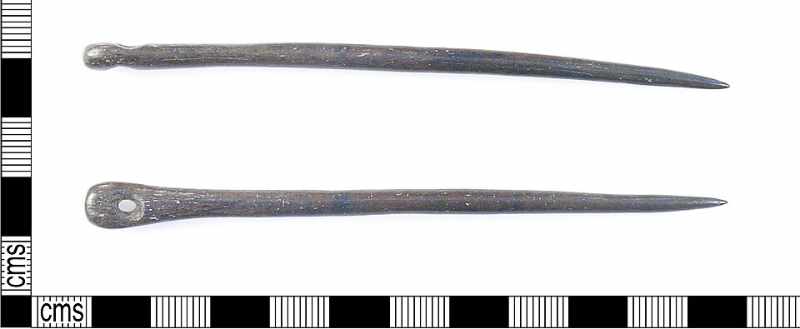
Before that, you could drape a skin over your shoulders, but you couldn’t make it fit close to your body, couldn’t layer it, couldn’t seal out wind. A draped hide in a Siberian winter isn’t going to cut it.
A stitched one, though? Anthropologists believe the sewing needle may have been one of the key technologies that allowed humans to leave Africa and spread into colder regions. People could move north because they could make clothing that actually protected them. The needle made migration possible.
I don’t know about you, but I’d never really connected “threading a needle” with “the entire pattern of human settlement.” It’s a blinding flash of the obvious, right?
The list of things needles made possible is astounding
Once humans could stitch, the possibilities kept expanding.
Stitched leather became armor. Stitched canvas became sails, which meant boats could travel further, which meant trade, exploration, and eventually the movement of people and ideas across oceans. Stitched fabric became tents, bags, shoes, flags. Surgeons used needles to close wounds. Bookbinders used them to hold pages together.
The Bayeux Tapestry, which records the Norman conquest of England in 1066, was made with needles and woolen thread, almost certainly by women in embroidery workshops (though we know none of their names).
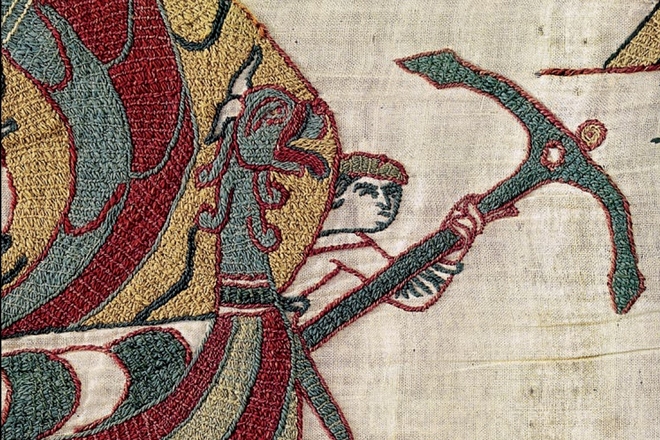
And yes, we wouldn’t have undies without needles. Or jeans. Or any garment with a seam, a hem, a button, or a zipper. Every piece of clothing you’re wearing right now exists because at some point, a needle passed through fabric.
In Japan, Sashiko stitching started as a way to reinforce worn clothing so it lasted longer. Everywhere, women turned fabric scraps into quilts to keep their families warm and tell the story of their lives.
In China, Suzhou silk embroidery is so refined that artists can stitch a completely different image on each side of a single piece of transparent silk, working from one side only, holding both designs in their head at the same time. With a needle. The skill!
The wheel gets the glory. Fire gets the glory. The sewing needle? Barely a footnote, despite the massive contribution they’ve made to who we are today as humans.
From bone to gold
The earliest needles were carved from bone, antler, and ivory using stone tools. They were precious. Losing one would have been a genuine problem.
As metalworking developed, needles followed. Copper first, then iron, then steel. The craft of needle-making became an industry. By the 18th century, the English town of Redditch was producing a million needles a year. Its reputation was so well known that a town in Japan reportedly renamed itself “Redditch” so it could stamp “Made in Redditch” on its packaging. (I love that story.)
Today, needles work at industrial scale. Workers in enormous factories run many thousands of sewing machines. Fast fashion depends on it (but let’s not divert into the exploitation of workers in some of those factories, stitching for long hours in poor conditions so the rest of the world can buy cheap clothes).
The industrial revolution made needles cheap and disposable for the first time. A tool that was once guarded like jewellery became something we toss in the bin without a thought.
Black needles?
On the other end of the scale, some hand-sewing and cross stitch needles have become things of beauty! Gold-plated needles glide through fabric with almost no friction. Titanium-coated ones resist wear and last far longer than standard steel.
Have you tried them? If you’re one of those stitchers (like me) whose skin eats through nickel plating in a few sessions, you’ll know the signs: needles going dark and rough mid-project. Gold and titanium hold up much better. Storing your needles in a dry place, like in felt pages, between projects helps too. We have a pattern for stitching your own needle book, all completely by hand.
I think there’s something fitting about coating a needle in precious metal, it’s a kind of recognition of the tool’s value, even if hardly anyone thinks of it that way.
Needles carry symbolic weight in folklore and tradition across the world. In Russian stories, a needle hidden inside an egg, inside a duck, holds the villain’s life force. Finding and breaking the needle is how the hero wins.
In parts of Japan, a needle wrapped in red cloth was placed in a newborn’s clothing to ward off evil. In many cultures, losing a needle was considered a bad omen, a sign that something valuable had been broken. This tells us something about how seriously people once took this tiny tool.
And one culture took it further than any other.
Hari Kuyo: giving your needles a funeral
Hari Kuyo translates to “needle memorial.” It’s a ceremony held every year at Shinto shrines and Buddhist temples across Japan, on February 8th in the Kanto region and December 8th in Kyoto and Kansai. Needle makers such as Misuya Chubei in Kyoto hold their own hari kuyo.
The tradition goes back over 400 years. Seamstresses, tailors, embroiderers, and home stitchers gather to give thanks to their needles for the work they’ve done over the past year. Broken and worn needles are brought to the shrine and gently placed into blocks of soft tofu or konnyaku jelly.
The softness of the tofu is deliberate. After a year of piercing tough fabric, the needle is given something gentle to rest in. I find that incredibly moving.
No sewing takes place on this day. It’s a moment to reflect on what was made, and to appreciate the tool that made it possible.
The ceremony comes from an animist tradition where everyday objects are believed to hold a kind of spirit or energy. A needle that has worked hard deserves a respectful farewell. Japan holds similar memorial ceremonies for brushes, knives, dolls, and even chopsticks. But Hari Kuyo is one of the most widely observed.
There’s a piece of folklore connected to this that I love. In some tellings, tools that are used roughly and discarded carelessly may, on their 100th birthday, transform into spirits called Tsukumogami and band together to take revenge on the wasteful. Obviously it’s folklore. But the message underneath it, about caring for the things we use, has stuck with me since I first read it.
Most of those attending are women, though tailors and other professional stitchers of any gender come too. Trades like sailmaking and shoemaking were men’s work, but the everyday stitching that kept families clothed and warm was done by women, mostly without pay or credit. I wonder if a ceremony that honours the needle honours that work too.
What I do with my old needles
I first heard about Hari Kuyo years ago on a blog that’s long since disappeared from the internet. But I’ve never forgotten it.
I don’t have a Shinto shrine nearby, and I don’t follow the Buddhist tradition. But I’ve ended up with my own version.
I keep an empty breath mints tin in my sewing machine cabinet and another in my cross stitch box. When I change a needle, the old one goes into the tin. When it’s full (years worth of sewing!), I dig a small hole in the garden, somewhere deep where I won’t be digging often, and I bury the needles.
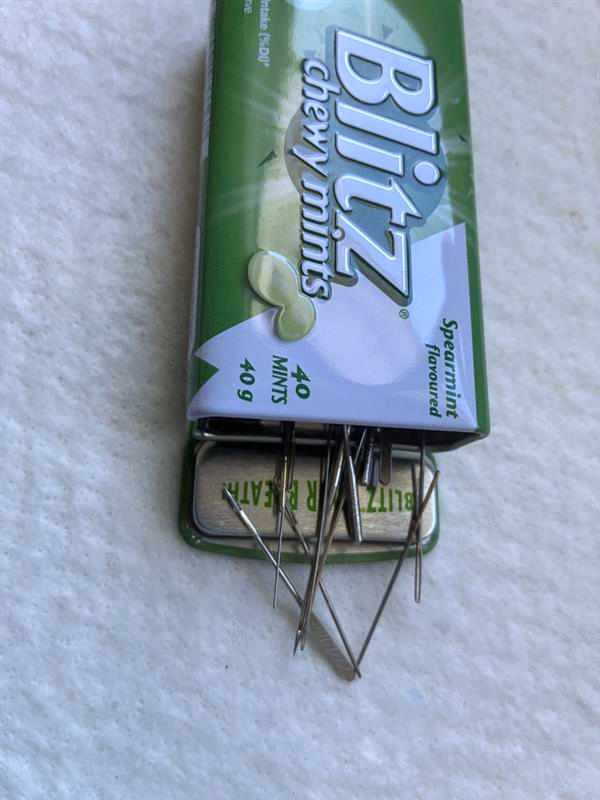
Steel needles rust and break down in soil over time. They return to the earth they were mined from. It’s one of those rare things in modern life where the end of something’s usefulness is also a genuinely complete cycle, back to the ground, no plastic, no landfill. We can’t do that with much anymore.
I take a minute while I’m doing it. I think about what I’ve made with those needles. The patterns I’ve stitched, the seams I’ve sewn, the hours of delight and creativity and calm they gave me. I couldn’t get lost in cross stitch, or make anything with my sewing machine, without them.
It’s a small, quiet thing that really only matters to me. But it’s changed how I feel about the tools in my hands.
If you’re not sure which needle type or size suits your stitching, our printable needle chart is a handy reference.
Over to you
Do you have a needle story? A favourite needle that lasted forever, or one that broke at exactly the wrong moment? Or maybe you’ve got your own way of retiring old tools?
We’d love to hear it. Please comment below.
Frequently asked questions
What is Hari Kuyo?
Hari Kuyo is a Japanese ceremony, held annually at Shinto shrines and Buddhist temples, where stitchers bring their broken and worn sewing needles to be laid to rest in soft tofu or konnyaku jelly. The tradition goes back over 400 years and is rooted in the animist belief that everyday tools deserve gratitude and a respectful farewell. “Hari” means needle and “kuyo” means memorial.
When is Hari Kuyo celebrated?
Hari Kuyo falls on February 8th in the Kanto region of Japan (including Tokyo) and December 8th in the Kyoto and Kansai region. No sewing takes place on this day.
How old are sewing needles?
The earliest eyed sewing needles found so far date to around 45,000 years ago. They were carved from bone in what is now Siberia and China. Anthropologists believe they were used to stitch animal hides into fitted clothing, which may have enabled humans to migrate into colder climates.
Why are needles placed in tofu during Hari Kuyo?
The tofu is deliberately soft. After a year of piercing tough fabric, the needle is given something gentle to rest in. It’s a symbolic act of tenderness and gratitude for the needle’s service.
What are the best cross stitch needles?
Most cross stitchers use tapestry needles, which have a blunt tip and a large eye. For a smoother stitching experience, gold-plated or titanium-coated needles reduce friction and last longer than standard steel. The right size depends on your fabric count. Our beginner’s guide to cross stitch covers how to choose the right needle for your project.
Why do my sewing needles go black or rough?
The natural oils and moisture in your skin can corrode the nickel plating on standard sewing needles. Some stitchers are more prone to this than others, and it can even change over time due to hormonal shifts. If your needles regularly tarnish or roughen while you stitch, gold-plated or titanium-coated needles hold up much better. They cost more, but if you’re burning through standard needles quickly, they can actually work out cheaper in the long run.


Leave a Reply